
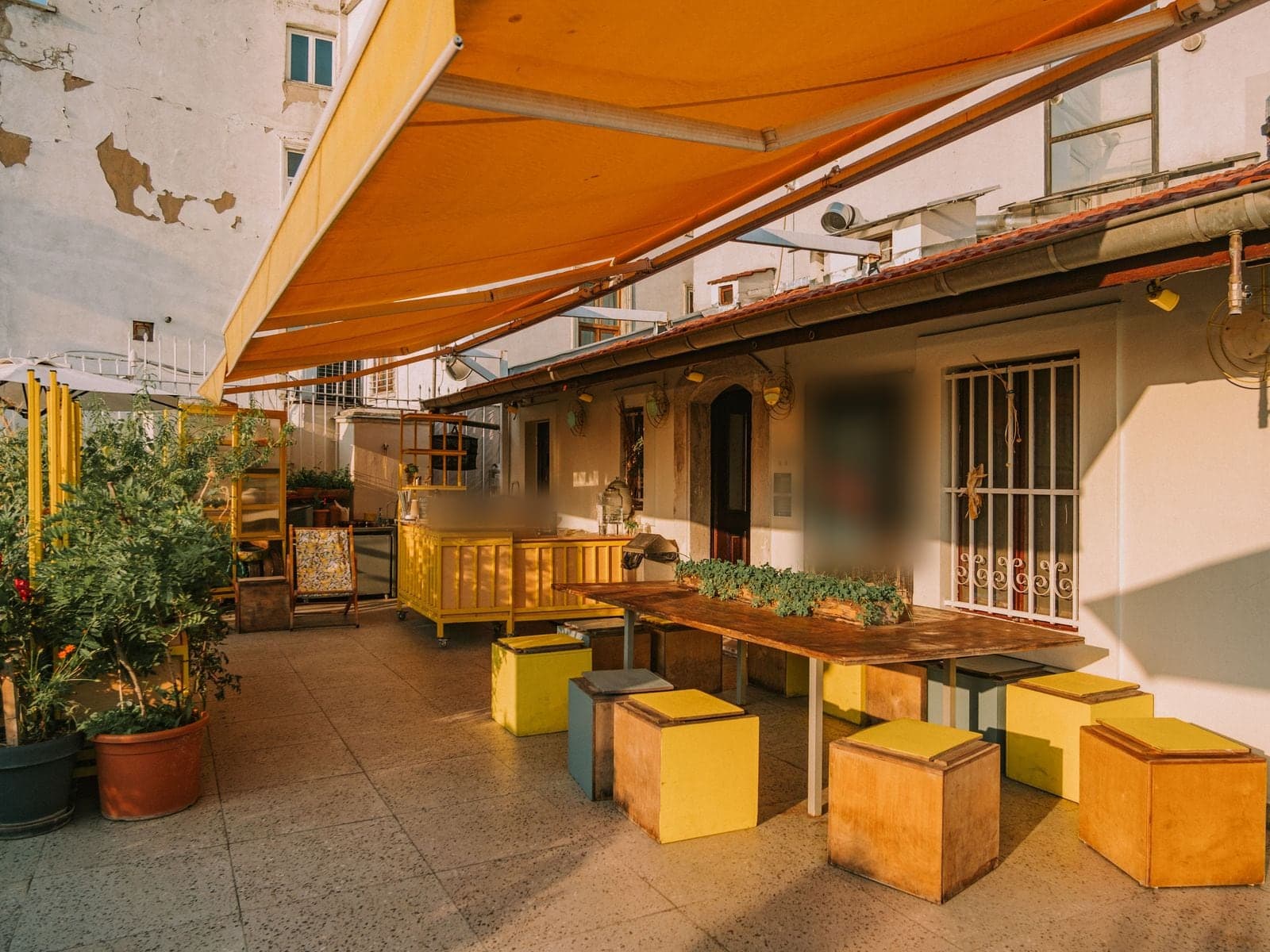
A retractable awning damaged by the wind can be repaired as long as the facade and wall brackets held: new fabric, folding arms replaced as a pair, a new front bar or motor. Replacement is needed if a bracket has torn out, the cassette is distorted or several parts are damaged. Do not force it closed, and isolate the power before anything else.
After the gale: make the awning safe
Storm Austen, the first storm of the autumn to reach France according to Météo-France, put all eight Île-de-France départements on orange wind alert on Friday 23 October 2026. An awning left extended in those conditions takes loads it was never designed for, and the damage is not always visible from the terrace.
Once the wind has dropped, look from the ground at the position of the awning, the shape of the arms, the line of the front bar, the state of the fabric and above all the brackets fixed to the facade. A bracket that has moved, a wall plug sticking out or render chipped under a support are the most serious signs, because the facade carries the whole awning. Somfy’s safety instructions for motorised products are plain about it: do not use the motorised product if it needs repair or adjustment.
Storm Austen in Paris: the damage to check on an awning
Wind acts on an awning like a sail: it lifts the fabric, opens or bends the folding arms and sends the full load back to the brackets anchored in the wall. The assessment therefore starts at the fabric and works back to the facade, part by part.
| Part | Visible signs | Usual fix | Warning sign |
|---|---|---|---|
| Folding arms | Visible signsArm bent, elbow forced open, fabric no longer taut | Usual fixArms replaced as a pair, pitch adjusted | Warning signArm support torn off the support tube or mounting bracket |
| Fabric | Visible signsTear, split seam, hem ripped, slack fabric | Usual fixSeam repaired or full recover | Warning signTear close to the roller tube or front bar |
| Front bar | Visible signsBar bent, end cap broken, awning closes crooked | Usual fixBar and end caps replaced | Warning signBar that struck the facade or a shop window |
| Brackets and fixings | Visible signsBracket working loose, anchor pulled out, render cracked | Usual fixNew fixings after checking the wall | Warning signWall or insulation torn away around the support |
| Roller tube | Visible signsFabric rolls up at an angle, rubbing, tube out of true | Usual fixTube replaced and fabric refitted | Warning signTube bent along with its support |
| Cassette | Visible signsCover open, end plate cracked, awning no longer retracts | Usual fixEnd plate or cover replaced if the part exists | Warning signCassette distorted along its length |
| Motor and limit switches | Visible signsMotor silent, awning stops short or strains when closing | Usual fixLimit switches reset or motor replaced | Warning signMotor that strained against a jammed awning |
Photograph each damaged part, then take a wide shot of the awning and the facade. Those pictures do two jobs: they help the technician prepare the parts and the insurer process the claim.
What can be repaired on a damaged awning
When the brackets and facade have held, awning repair after a gale deals with the damaged parts without changing the frame:
- The fabric: a split seam can be restitched, while a tear or worn fabric calls for awning fabric replacement on the existing frame.
- The folding arms: they are replaced as a pair, so both sides tension the fabric equally and the front bar stays level.
- The front bar and its end caps, when it has bent without tearing out the arms.
- The motor, its limit switches or its control point, with a new awning motor if needed.
- The fixings, refitted after checking the wall, the render and the insulation.
Refixing a bracket needs a sound wall. On a facade with external insulation or crumbling render, the technician first checks what the wall can carry, because an anchor set back into a hole enlarged by the pull-out will not survive the next gale.
When to replace the awning rather than repair it
- A support torn out with part of the wall or insulation: the facade has to be repaired before any refitting.
- A distorted cassette: it no longer protects the fabric or the motor, and the awning will not close properly.
- Several parts damaged at once, for example the arms, front bar, roller tube and fabric.
- An old model whose parts can no longer be found.
- A wish to upgrade: moving from an open awning to a semi-cassette retractable awning or a full cassette awning, whose fabric is better protected once retracted.
A new awning installation then reopens the questions of fixings, facade exposure and the wind resistance class stated by the manufacturer. It is also the right moment to add a wind sensor and suitable controls.
Avoiding the next breakage: wind sensors and resistance class
A wind sensor helps, but it has limits. The Somfy Eolis sensor instructions explain that it retracts the awning when wind vibrations exceed its set threshold. They also state that it does not protect the awning against strong gusts: when that risk is forecast, keep the awning retracted.
Nice presents its outdoor awning automation as able to close automatically in wind or rain, and its Volo S Radio sensor has adjustable thresholds. A threshold set too high retracts the awning too late, so have it checked when the system is commissioned.
An awning’s wind resistance is a class declared by the manufacturer under the EN 13561 standard. It appears in the product documentation, and it is that class, not guesswork, that tells you how far the awning can stay extended. Ask for it before buying and stick to it day to day.
- Retract the awning when you are away and overnight.
- Retract it as soon as strong wind is forecast, with or without a sensor.
- Have the arms, fixings and fabric checked during regular awning servicing.
- Report flapping fabric or a knocking arm at the first sign.
Insurance: claiming for an awning damaged by the wind
Insurance policies covering damage to property include, for the assets they insure, cover against the effects of wind caused by storms: this is the storm cover of Article L122-7 of the French Insurance Code. It is separate from natural disaster cover, which requires an interministerial order recognising the event. Storm wind generally falls under the storm cover, provided the awning is among the insured assets.
Photograph and keep
Photograph the awning, the facade and any fallen parts before moving them. Keep the broken parts: Service Public advises keeping damaged items.
Report within the deadline
Report the loss within your policy’s deadline; Article L113-2 of the French Insurance Code prevents that deadline from being shorter than five working days.
Add a repair quote
The technician’s quote, listing the parts to replace, completes the claim. Ask the insurer whether a loss adjuster will visit before you order a new awning.
If you rent, tell the landlord and your insurer: the lease and the policies say who pays for the repair. In a building held in co-ownership, an awning fixed to the facade may also involve the building’s insurance, so report the damage to the managing agent, especially if the facade is damaged.
Replacing an awning in a co-owned building or on a Paris shopfront
In Paris, the city points out that co-owners’ approval is generally needed before installing an awning whenever the exterior appearance of the facade changes, and that planning permission may be required under Articles R.421-13 to 17 of the French Planning Code. For a shop, the Paris rules on terraces and displays state that changing the shopfront requires planning permission.
For a like-for-like replacement, with the same size, fabric and colour, do not assume that no formalities apply: ask the managing agent and the planning department before ordering, especially if you change the model or the colour.
How we handle a broken awning
Making safe
The technician isolates the power, holds or retracts the awning depending on its condition and clears the area beneath the fabric.
Full inspection
Arms, fabric, front bar, roller tube, cassette, motor and above all the brackets and facade are checked, so new fabric is never fitted to a weakened support.
Written proposal
Targeted repair or replacement, with the parts listed, ready to add to the insurance claim.
Work and testing
Parts fitted, limit switches and pitch adjusted, wind sensor checked if one is fitted, then several opening and closing cycles.
Shasama Fermetures works on retractable awnings across Paris and Île-de-France, including Somfy, Nice and Simu motors. Send photos of the awning and its fixings through the quote request form, or describe the damage on 01 87 66 40 33. If your shopfront also has a damaged metal shutter, our guide to a broken metal shutter, repair or replace covers the same decisions.